
Every orgasm release oxytocin which improves mood by providing a feel of being loved. Regular sex has shown to make your heart beat stronger, reduces stress and depression, improve your self-esteem and improves sleep.
Health Benefits of Sex
Increase your life span and reduces mortality
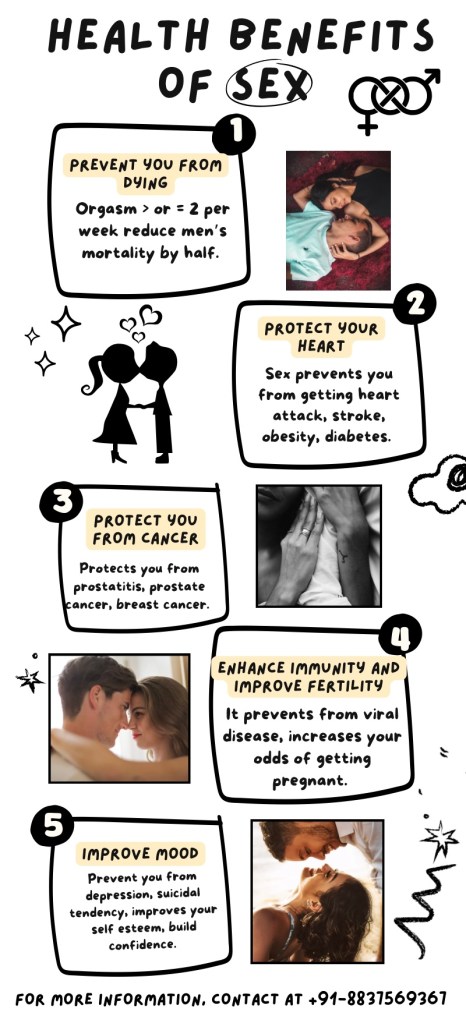
Sexual activity have a protective effect on men’s health. It has been found that the men who had frequent orgasms of 2 or more per week have 50 % less chances of dying than men who had <1 orgasm per month. It has been seen that mortality is higher among men who ceases sexual intercourse at earlier ages.
For women, the frequency of intercourse has not shown to improve the life span, however, it has been found that the women who had past experience of enjoyable sex usually live longer.
Protects you from heart disease, stroke and metabolic diseases
Increased frequency of intercourse (2 or more per week) has shown to lower the risk of fatal heart attacks in men by 50%.
Women who are unable to achieve orgasm during coitus that lead to emotional distress, and/or a lack of orgasm/sexual enjoyment/sexual intercourse due to a partner’s illness or impotence, have higher incidences of heart attack.
The release of DHEA after orgasm play a protective role against heart disease in both men and women.
Frequent penial vaginal intercourse (conventional sex) lead to decrease in hip and waist circumference in both men and women, thereby decrease the risk of type 2 diabetes and coronary heart diseases. Masturbation or other forms of sexual activity has less or no effect of hip and waist circumference.
Protection against Cancer
Frequent sexual activity lead to deceased risk of cancers like breast cancer, and prostate cancer.
Oxytocin released during orgasm has a protective role in breast cancer in both women and men. According to a case control study, the women who developed breast cancer, had practiced less frequent sexual activities.
According to another study, a woman’s lifetime risk of breast cancer decreases with increasing number of male sex partners (as seen in multiple marriages), due to elevated immune response against different sperm antigens, as well as fetal antigens.
Frequent ejaculations of more than 21 per month in men, can protect them from prostate cancer and chronic non-bacterial prostatitis. With each incremental increase of 3 ejaculations per week throughout a lifetime is associated with a 15-percent decrease in the risk of prostate cancer.
Increased frequency of ejaculations lead to flushing of potential carcinogenic
substances from the prostate, and the relaxation and stress relief following ejaculation reduces central sympathetic nervous system activity that can cause cell multiplication as seen in cancer.
Enhances your immunity
People who have sexual intercourse once or twice a week have IgA levels, that protects against viral infections, 30 percent higher than those who are abstinent. However, the people who practice intercourse 3 or more times a week, have similar IgA levels.
Improves Fertility
Sexual intercourse four or more times a week can give you an 80 percent chance of getting pregnant within six months. However, the chances of conception drop to 17 percent if a woman has intercourse less than once a week.
Timing of orgasm can also affect the likelihood of conception. According to a study, women who achieve orgasms during intercourse after their male partners’ ejaculation, retain more sperm than those who did not reach orgasm or who had orgasm before their partners ejaculated. It has been seen that if sperm are retained for 10–15 minutes in the vagina, fertilization rate is higher.
Oxytocin released during orgasm enhances the peristaltic waves that run along the uterine wall towards the ovulating ovary, aiding the transportation of capacitated sperm.
Greater excitement in men during sexual intercourse and masturbation on frequent basis can improve the quality of the ejaculate.
Maintains Menstrual Regularity
The women who engage in penile vaginal intercourse at least once every non menstruating week have regular cycle lengths than women who had coitus once in a blue moon.
Also, masturbating can relief you of menstrual cramps also.
Improves Mental Health
Masturbation was associated with a decreased risk of depression. Sexual satisfaction is directly associated with an increased frequency in sexual intercourse and is inversely related to depression. It is seen that the tendency of suicidal behaviour and depression is high in celibate, and self-identified homosexuals.
Sex is also inversely related to violent behaviour seen in men. In 2005, it was reported that 67 percent of 24 cultures that accepted premarital sex were considered to be nonviolent, while 73 percent of 11 cultures that did not approve of premarital relationships experienced high levels of violence.
Sexual activity and orgasm have been shown to reduce stress. It also raises self esteem in both men and women. A correlation was also found between masturbation and self-esteem — women who reported masturbating, scored higher on the self-esteem index than women who did not report masturbating. Women who masturbate have a more positive body image and less sexual anxiety.
Sexual activity has also been shown to be beneficial in reducing the severity of alexithymia — a psychiatric construct, or personality trait, characterised by a difficulty in identifying and distinguishing between human emotions. That means, men and women who engage in sex more often, are emotional stable.
Safe Sex practices
- Use Condoms each time: It not only prevents unwanted pregnancy, but also prevents Sexually transmitted diseases (STDs)
- Choose safe place, safe position
- Avoid filming
- Give time to each other
- Read before trying new things
- Get your regular health check up to prevent STDs
- Maintain personal hygiene regularly
- Avoid multiple sexual partners
- Avoid getting intoxicated with alcohol, drugs, etc.
- Avoid crazy things like use of large foreign bodies etc.
Conclusion:
Sexual pleasure is an important aspect of life. It helps in maintaining physical, psychological and emotional wellbeing of the body. It improves the condition of your heart, mind, immune system and prevent from developing obesity, stroke, heart attacks, diabetes, depression, and breast and prostate cancer. However, sex should be practiced with caution and preventive measures should be considered for unwanted pregnancies and STDs.


 Dr Anadeep Chandi
Leave a reply to anachandi Cancel reply