
Sleep is very important pillar of healthy lifestyle which sustains life. About one third of human life is spent while sleeping. Sleep helps in rejuvenation, reenergise and prepare the body for the next day. Sleep helps in building the circadian rhythm which is very important for the brain to signal reproductive functions through gonadotropin releasing hormone (GnRH) and luteinizing hormone (LH) released from hypothalamus and pituitary gland.
Randy Gardner, a 17 year old boy set an unbeatable record of 264 sleepless hours (approximately 11 days) in 1965. It has been seen that prolonged sleep deprivation cause impaired cognitive function, irritability, lack of concentration, lethargy, altered state of consciousness and memory loss. Chronic impaired sleep lead to cardiovascular diseases, glucose dysregulation, psychiatric and neurodegenerative disease, and dysregulated immune function.
A healthy sleep pattern consists of recurring cycles of 90–120 min, comprising 4 to 6 phases of alternating rapid eye movement (REM) and non–REM sleep.
Role of Melatonin and sleep
Disturbed sleep pattern deregulate the release of Melatonin hormone from pineal gland. Melatonin hormone is essential in synchronising the circadian sleep pattern and has anti-oxidant, anti-inflammatory and anti-apoptotic activity. Abnormal melatonin hormone disturbs puberty changes, alter the menarche period, decreases oocyte quality by exposing the oocyte to excessive oxidative stress.
Sleep and Stress
Chronic insomnia leads to HPA axis activation causing elevated stress hormone responses by increasing levels of plasma cortisol releasing hormone (CRH), adrenocorticotropic hormone (ACTH) and cortisol. Also, sustained stress increases cortisol levels and may induce sleep disorders like impaired sleep quality and shortened sleep duration making it a vicious cycle.
Sleep and Reproductive Hormones
- Sleep disturbance lead to dysregulated LH release with abnormal release of LH hormone from pituitary gland during various phases of menstrual cycle. LH amplitude increases with partial and total sleep deprivation.
- FSH levels are 20% lower among women who are short sleepers compared to long sleepers (>8 hrs per night).
- Also, individuals with night eating syndrome had increased levels of prolactin which can be a stress-regulatory response to cortisol. Women with narcolepsy (with or without sleep apnea) had lower levels of prolactin release.
- Total sleep deprivation due to depression can decrease testosterone levels in men and women.
- Women with regular sleep schedules had 60% lower levels of estradiol, as compared to women with variable sleep schedules.
All these hormones play essential part in folliculogenesis, endometrial preparation and pregnancy regulation.
Sleep and Hormonal imbalance disorders
Hormonal imbalance causing disorders like PCOD/ PCOS can also cause sleep disturbances. Hyperandrogenemia, insulin resistance, abnormal melatonin, and/or psychosocial sequelae (depression and anxiety) seen in such patients lead to sleep disturbances. It is being seen that women with PCOS report sleep disturbances like difficulty achieving and maintaining sleep twice as likely. They are also 30 times more likely to suffer from sleep disordered breathing.
Sleep disturbance and PCOS goes bi-directional. According to a large population-based multicenteric survey, long-term rotating night shift work for more than 2 years was associated with increased risk of PCOS, by causing genome-wide disruption of the circadian rhythm in granulosa cells of women with PCOS.
Sleep and fertility treatment
Sleep loss or insomnia might affect conception by compromising immunity. Sleep loss induces elevated immune inflammatory response marked by TNF, IL-6 and cytokines. Poor sleep quality also leads to elevated C-reactive protein (CRP) in young women.
Limited sleep duration (≤7 hours) is inversely related to fertility compared with 8 hours of sleep. High intensity physical activity and limited sleep time decrease fertility and prolong the conception interval.
According to a study, couples whose female partners reported trouble in sleeping for more than 50% of the time had reduced fecundity when compared to women who reported no trouble in sleeping. Couples whose male partners slept less than six hours a night had significantly reduced fecundity when compared to men who slept eight hours or more at night.
In another study conducted on Swedish Midwives, midwives who worked in rotating two-shift, three-shift, or only night shifts had reduced fertility compared to those working only in the daytime.
Among women undergoing IVF, shorter sleep duration and shift work were associated with fewer mature oocytes retrieval and higher rates of implantation failure. This can be bi-directional. Prolonged infertile period can be associated with higher stress levels and reduced sleep quality. It has been seen that greater than 35% of women undergoing intrauterine insemination treatment report disturbances in their sleep.
Sleep and Pregnancy
Shorter sleep duration, and shift and night work are associated with higher rates of miscarriage.
Sleep disordered breathing, long and potentially short sleep duration, and poor sleep quality is also linked to hypertensive disorders of pregnancy, gestational diabetes, lower birth weight babies, preterm deliveries, prolonged labour and higher rates of cesarean section.
Preeclampsia women face sleep disturbances in form of increased time spent in slow-wave sleep, longer latency to REM, reduced time spent in REM, and increased total movement time and total frequency of body movements in bed.
Sleep and Male Infertility
Impaired sleep with short or long sleep period and late bedtime impair the semen quality probably via increased production of seminal anti-sperm antibodies and reactive oxygen species (ROS). Increased ROS lead to high sperm DFI that can cause difficulty in conception, and increased chances of abortions. There are various studies linking sleep disturbances with idiopathic male infertility and low sperm count as well.
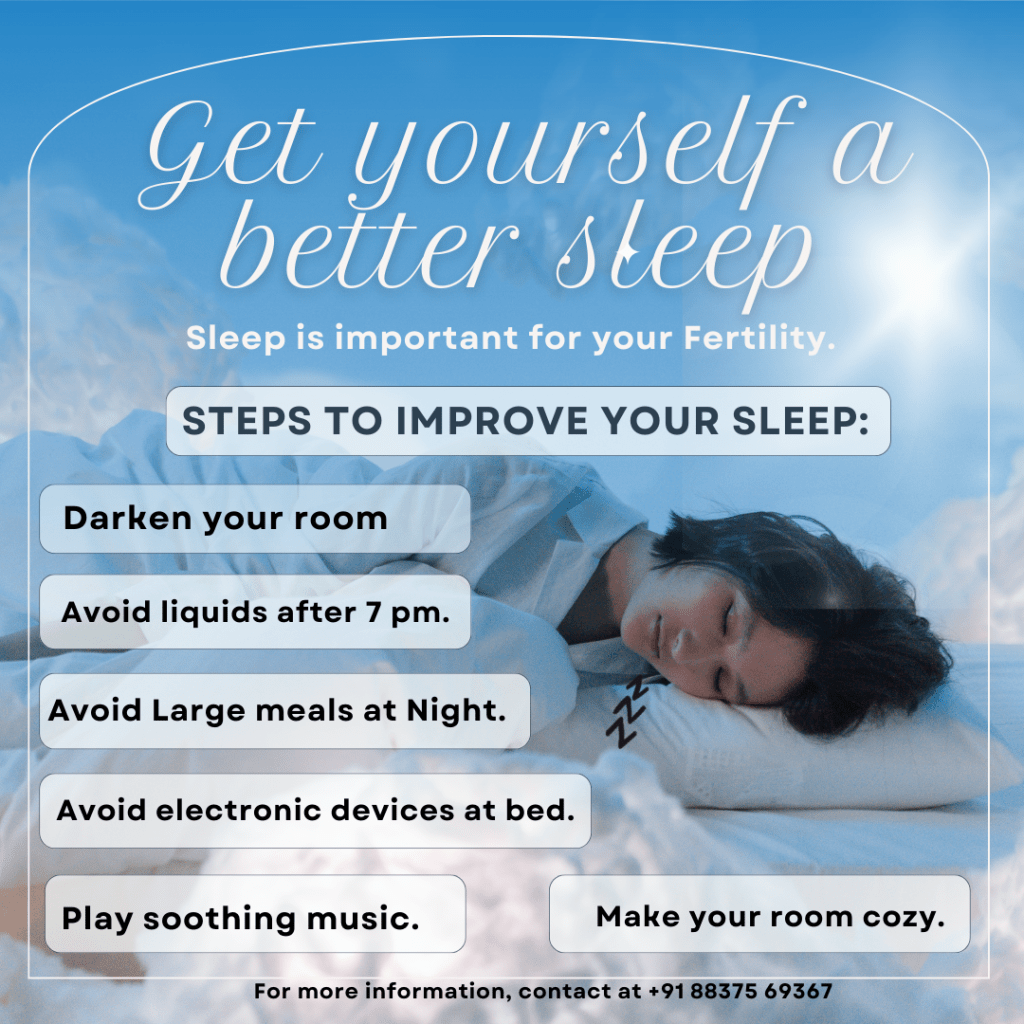
How to improve sleep quality?
Certain changes in your lifestyle can improve your sleep quality.
- Exercise regularly
- Meditate daily
- Avoid heavy meals after 8 pm
- Avoid fluids after 8-9 pm
- Avoid loud noises at night, instead play soothing music during bed-time
- Fix your room temperature in comfortable zone
- Follow fixed day and night schedules
- Avoid use of mobile phones, laptops, iPad, TV, and other electronic devices during bed-time
- Use head phone or ear plugs for noise cancellation
- Use eye cover pad
Conclusion
Disturbed sleep has harmful effects on various parts of the body. It leads to neuro-endocrine, physical and psychological impact on the body. It also reduces fertility potential and negatively impacts the fertility treatment outcomes. Therefore, strong efforts should be put seriously for improving the sleep quality, so that the body can perform various life sustaining functions efficiently.
Read more: Can Sleep Disturbance effect your fertility?

 Dr Anadeep Chandi
Leave a reply to Dr. K Anil Roy Cancel reply