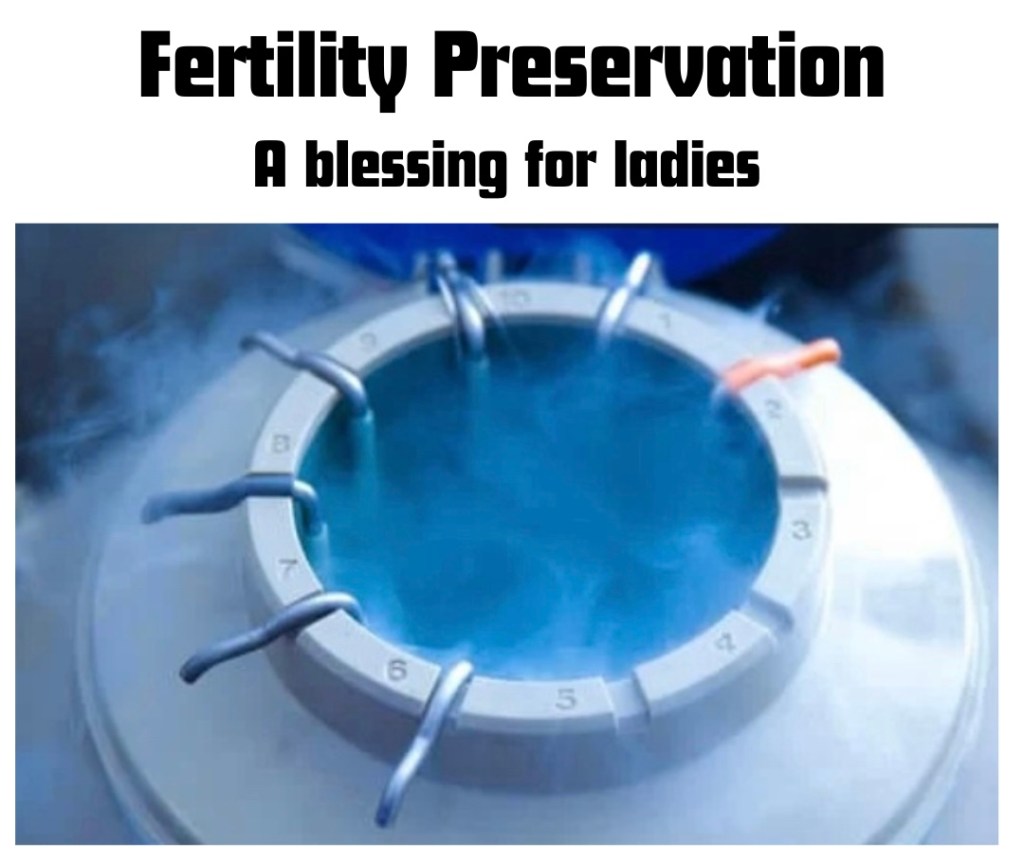
With many celebrities coming up with the news of oocyte freezing and having a child at an age of their own wish, fertility preservation has become a topic of gossip in the ‘B’ town society. However, medically speaking, it is a very important topic that need to be emphasised in the general population who may or may not be career oriented. In this article we shall discuss the various conditions that can be appropriate for fertility preservation.
Fertility preservation is a technique by which fertility of men and women can be preserved for future use.
Conditions in which Fertility preservation should be done:
- Non malignant conditions
- Conditions that need Bone marrow transplantation
- Sickle cell anemia
- Thalassemia major
- Aplastic anemia
- Autoimmune diseases unresponsive to immunosuppressive therapy
- Autoimmune diseases requiring chemotherapy
- Systemic lupus erythematosus
- Rheumatoid arthritis
- Behcet’s disease
- Wegener’s disease
- Multiple sclerosis
- Ovarian pathologies
- Recurrent Ovarian cysts
- History of Ovarian torsion
- Endocrine or genetic diseases
- Turner syndrome
- Galactosemia
- Family history of premature ovarian failure
- Sex reassignment surgery in transsexuals
- Conditions that need Bone marrow transplantation
- Malignant conditions
- Cancers detected in childhood and adolescence
- Metastatic Ewing’s sarcoma
- Hodgkin’s disease
- Soft tissue sarcoma stage IV
- Neuroblastoma
- Non-Hodgkin lymphoma
- Acute myeloblastic leukemia
- Hepatoblastoma
- Osteosarcoma
- Neuroblastoma
- Retinoblastoma
- Conditions where whole body irradiation has to be given
- Cancers detected in childhood and adolescence
- Social reasons
- Delayed marriages due to unemployment, career prospects, financial instability
- Couples not ready for parenthood
Concept behind fertility preservation
Women have a biological clock that continues ticking. The reproductive age group of women is considered between 18 – 45 years. In this age group, the best fertility potential lies between 20 to 32 years, after which the fertility potential starts declining at a faster pace. Throughout a women’s lifetime, she will ovulate for around 400 times. Some women consume these egg early in their life and some continue to ovulate one by one till later age of life as well. There are certain factors that can affect this process by depleting the eggs at a faster pace.
Fertility preservation helps to pause this biological clock and give the women a chance to use these preserved eggs later in their life.
The radiotherapy and chemotherapy used in cancer patients has gonadotoxic effect. They disrupt the growth of ovarian cortex, and causes apoptosis of the growing follicles. The radiotherapy using radiation dose intensity of ≥6 Gy in adult women, ≥10 Gy in postpubertal girls, and ≥15 Gy in prepubertal girls can negatively impact the fertility potential of the ovaries.
Chemotherapeutic drugs act at the level of the nucleus to cause DNA damage or interfere with DNA transcription and replication and cause cell apoptosis. Certain cancers need treatment with gonadotoxic chemotherapy drugs that have high impact on future fertility. Cancer patients should be informed regarding such side-effects as well. It has been seen that chemotherapy-induced amenorrhea is seen in 53% to 89% in patients with breast cancer.
Types of fertility preservation procedures:
• EMBRYO CRYOPRESERVATION
• OVARIAN TISSUE CRYOPRESERVATION
These methods of cryopreservation are invasive and requires minor or major surgery at least once. Oocyte and embryo cryopreservation requires ovarian stimulation and removal of eggs outside the body through oocyte retreival procedure. These eggs can be freezed, as in oocyte cryopreservation, or can be fused with sperms of the partner if available. The resultant embryos formed are then freezed for later use.
Ovarian Tissue Cryopreservation was first done in 1999 and was considered experimental till 2019. This technique is adopted for younger prepubertal and adolescent girls who have not established the process of regular ovulation yet. A total of 130 healthy babies have been born through this technique till now.

It involves 3 steps:
• Ovarian tissue harvesting which involves laparoscopic removal of ovary or part of ovary outside, and slicing this ovarian tissue into thin slices.
• Ovarian tissue cryopreservation involves freezing these thin slices
• Ovarian Autotransplantation involves reposting back these tissue slices back into the body after warming them.
Another invasive technique of fertility preservation is ovarian transposition and used in cancer patients who requires pelvic radiotherapy. This is less effective and can have high failure rates.
Other non invasive methods of fertility preservation are use of GnRH agonist or oral contraceptive pills for long duration. These have less efficacy.
Side effects of Fertility preservation techniques
- Invasive: most techniques are invasive in nature that involves surgery and anaesthesia
- Frequent hospital visit for 15-20 days
- Injection site pain
- Frequent blood sampling
- Mild sedation, slight weight gain,
- Need of anaesthesia during OPU, bleeding during OPU, prolonged hospitalisation
- Mild pain abdomen
- Slight risk of OHSS in PCOD patients
- Dual surgery in case of ovarian tissue cryopreservation
Is embryo freezing better than oocyte freezing?
Yes, Embryo freezing has comparatively higher efficacy and survival rate as compared to oocyte freezing. Egg being larger in size, has high water content, low membrane permeability, are more prone to damage during freezing and thawing (warming) procedure.
What legal issues a person who undergo such procedure can face?
The transportation of gametes and embryos are not allowed from one state to other state and from one country to other as per new ART rule of government of India. That means, if a woman finally decide for motherhood, the rest of the procedure need to be done in the primary fertility centre only.
In case of death of the individual who underwent cryopreservation, the gametes may be needed to disposed off.
The couple who underwent embryo cryopreservation, may have trouble in gaining the ownership of embryos in case of marital disputes. The government of India has a soft corner the woman than man in such cases.
What is semen cryopreservation? Who should undergo this procedure?
Men who are diagnosed with testicular cancer, or testicular trauma, need testicular irradiation due to any cause should undergo semen freezing. The semen freezing has a survival rate of around 70%, as sperms are considered to be fragile and has poor tolerability to freezing and warming procedures. It is recommended, that such men should undergo at least 2-3 vials of sperms freezed. Prepubertal boys may undergo testicular tissue cryopreservation as sperms production start only after puberty is attained. However, it is still under experimental phase.
Summary
Fertility preservation is an important and efficient technique of preserving fertility potential of individuals who are not planning for parenthood in near future. It is medically indicated mainly in cancerous patients and non medical indicated in individuals who have other priorities in life than having a baby of their own. Prepubertal and adolescent girls can opt for ovarian cortical tissue cryopreservations. Unmarried women can undergo oocyte freezing. Married couple who are not planning for parenthood any sooner should undergo embryo freezing.

 Dr Anadeep Chandi
Leave a comment